All thingsconsider, using a properly designed lenshood or lens shade is the best and most convient way to mininmize flare in your picture. As numerous instruction books and magazine suggest, it's most important to use a lenshood when shooting outdoors in bright sun light, especially when you point your lens toward the sun, or if you include any other bright light sources in your picture.
The Trouble with all this good advice is that it doesn't always work. When shooting against the light, even well designed lenshood may not prevent flare at certain angles. Shade for zoom lenes can only be optimized for specific focal lengths and may be less effective at wider or longer setting. And unless lens shade are built in and retractable, or stow on the front of the lens in reverse position while still allowing access to the control rings, many photographers leave home without 'em.
What can you do if you find yourself hoodless in the blazing sun, or your finder flares up when you're shooting a backlit scene? Walker Seven, our senior lab technician, picked up some effective dodges for dealing with this age-old dilemma by observiing a number of New York pros taking pictures in Central Park. He noticed that few of them used lenshood at all, even when shooting with long teles and zoom, but many employed their hands, arms, thumbs, and wallets in fascinating ways to keep Old Sol from ruining thier pictures.
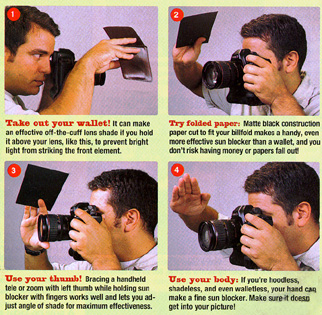
There are no hard-and-fast rules to this hoodless flare-fighting game: basically, if it works, do it. However, we offer the following suggestion on methods we've seen in use and found to be effective. As is the case with real lenshoods, black or dark gray matte-finished materials make the best sun blockers. If your wallet (photo 1) meets these criteria, fine; if not, get a piece of matte black construction paper and make a folder shaped shade that fits your billfold. (photo 2) Hold it about 10 to 12 inches above the front of the lens, point it in the direction of the sun, and move it back and forth and side to side until you get get maximum sun-blocking effect without the shade blocking any part of your viewfinder image. This is somewhat easier to do if your camera is mounted on a tripod. With a handheld tele, try bracing the front of the lens with your outstretched left thumb while positioning the sun blocker with your finger (photo 3). As a last resort, you can use your hand to shade your lens, always using your SLR's viewfinder as your guide (photo 4).
Surprisingly, your biggest ally in your fight against flare isn't your ingenuity in designing impromptu sun blockers, it's your SLR's viewfinder. In almost all cases, what you see is pretty much what you'll get. So, if you observe flare hot spots, ghost images, or overall low contrast image degradation when ogling through your SLR's eyepiece, you can bet that your on-film results will look at least as bad abd possibly worse. However, thereverse is also true. If, by shifting your angle slightly or using one of the lens shading methods shown here, you can clear up or significantly enhance the in-finder image, you may rest assured that your picture will be similarly improved.p>There are two key points to bear in mind: 1. Carefully check all corners and edges of the finder to make sure that a bit of your arm, hand, finger, or lens shading device is not in the frame. 2. Closely observe the entire viewfinder field right up to the instant of exposure to make certain that slight shifts in lighting or light-blocker orientation do not cause unwanted changes.
If all this inspires you to bring along that lenshood next time you're out shooting, good, because all of these methods will work as well or better with a lens shade in place. And with a good lenshood on your lens there's a fair chance you might not have to resort to any of these tricks. (taken from Popular Photography Oct. 1999)